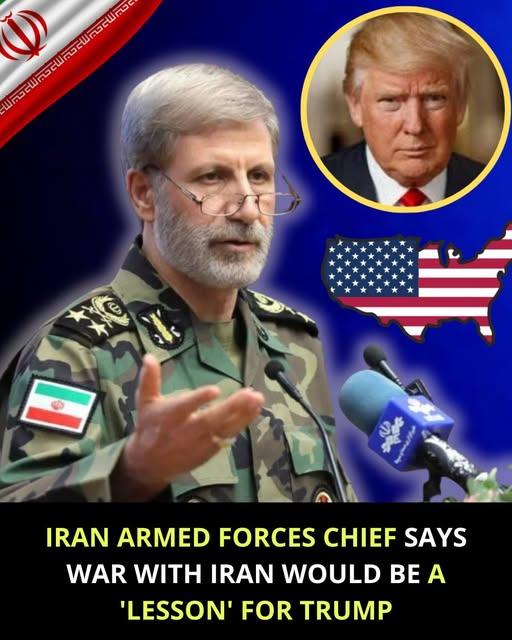
Iran’s Armed Forces chief, Major General Abdolrahim Mousavi, delivered a sharp response to rhetoric from U.S. President Donald Trump, questioning the consistency of Washington’s messaging.
“If Trump intends war, why does he speak of negotiations?” Mousavi said during a public address, warning that any military confrontation with Iran would become a “lesson” for the U.S. president. He added that such a conflict would leave Trump unable to act as a global bully — remarks that quickly spread through Iranian state media and regional outlets.
The exchange highlights rising tensions between Tehran and Washington amid a complex geopolitical backdrop. In recent months, the two sides have pursued parallel tracks: indirect nuclear diplomacy — often mediated by Oman and Qatar — alongside escalating rhetoric, increased U.S. military presence in the Gulf, Iranian missile activity, and repeated warnings from both governments.
Trump’s public posture has alternated between calls for renewed “maximum pressure” and openness to negotiating a new nuclear agreement. Iranian officials, meanwhile, have consistently portrayed U.S. military signaling as preparation for potential aggression rather than sincere diplomacy.
Mousavi’s comments fit a familiar pattern of deterrence messaging from senior Iranian military leaders, who frequently use forceful language to project resolve and discourage miscalculation. The remarks also underscore persistent regional flashpoints, including proxy dynamics in Yemen, Iraq, Syria, and Lebanon.
For now, there is no clear indication of imminent military action by either side. Still, the sharp rhetoric illustrates how quickly verbal exchanges can elevate perceived risks and complicate already fragile back-channel efforts aimed at reducing tensions.
