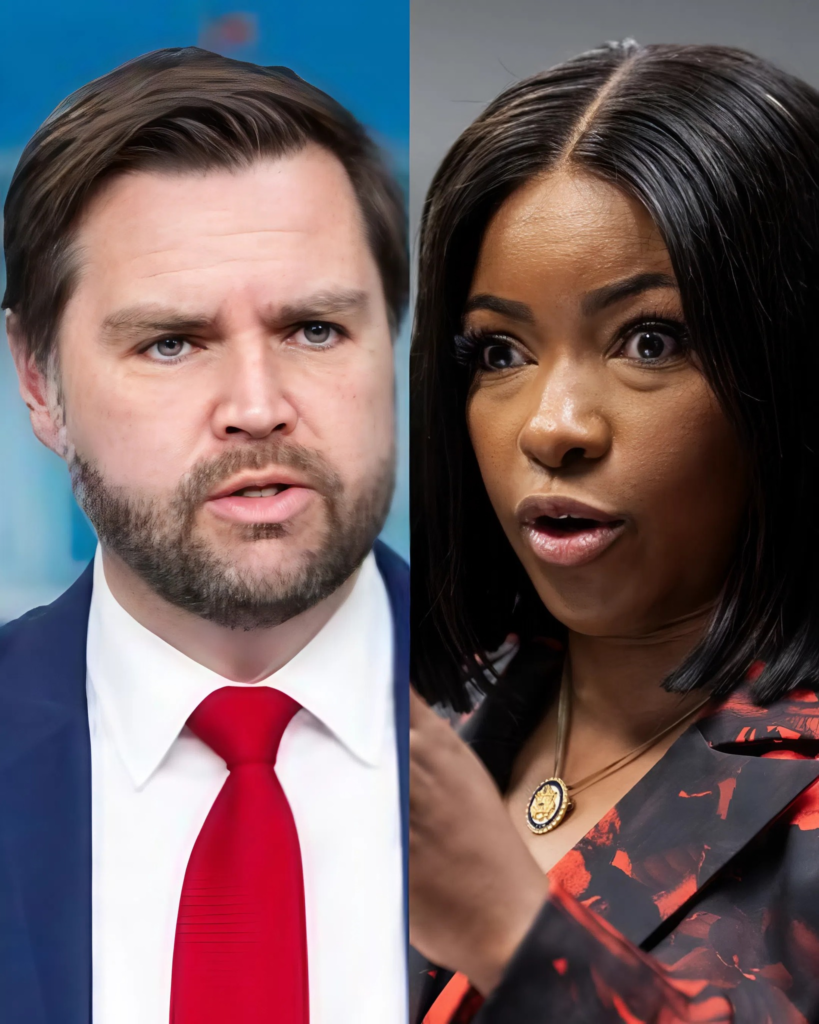
A sharp political confrontation that unfolded under studio lights has now moved into federal legal territory after Jasmine Crockett filed an $80 million defamation lawsuit against JD Vance and a national television broadcaster following remarks made during a live political program that rapidly triggered backlash across Washington and beyond.
According to legal representatives involved in the filing, the complaint was submitted within hours of the televised exchange and accuses both Vance and the network of publishing and amplifying statements that Crockett’s legal team argues caused serious reputational harm, damaged professional standing, and created measurable political consequences.
The lawsuit centers on comments delivered during a prime-time policy discussion that had originally been scheduled to focus on congressional oversight, federal spending, and executive accountability. What began as a structured panel conversation shifted dramatically when Vance directly challenged Crockett during a segment addressing recent legislative disputes.
Witnesses inside the studio described the atmosphere changing immediately after Vance interrupted Crockett mid-response and launched into criticism that was sharper than earlier exchanges.
“You can keep repeating talking points,” Vance said during the broadcast, “but facts do not change because volume increases.”
Moments later, he escalated further by referencing what he described as “patterns of public misrepresentation,” a phrase that quickly drew visible reaction from both moderators and audience members present in the studio.
According to attorneys for Crockett, the legal complaint specifically identifies statements made during this portion of the exchange as defamatory because they allegedly implied intentional dishonesty and misconduct in official public duties.
Rather than respond emotionally, Crockett maintained a controlled tone throughout the segment, asking for time to complete her answer while insisting that public accusations made on national television must be supported by verifiable facts.
“I will defend my record every time,” she said during the program. “And I will not allow anyone to distort my service to the people I represent.”
Those remarks were followed by a brief silence in the studio before moderators attempted to move the discussion forward.
Behind the scenes, however, legal preparations were already underway.
By the end of the broadcast, representatives for Crockett confirmed that court documents had been finalized and electronically filed, naming both Vance and the network that carried the exchange as defendants.
The filing alleges that the network failed in its editorial responsibility by allowing repeated statements to air without immediate factual clarification or corrective intervention.
Attorneys argue that because the remarks were delivered in a high-profile political setting with millions of viewers, the reputational impact expanded instantly across digital platforms, political commentary channels, and campaign-related media.
The lawsuit seeks $80 million in damages, citing injury to professional credibility, emotional distress, legal costs, and long-term public consequences.
Legal analysts noted that the amount reflects not only the scale of the accusation but also the national reach of the broadcast itself.
Within hours of the filing, clips of the exchange circulated widely online, with supporters of both political figures debating whether Vance’s language crossed into personal accusation or remained protected political speech.
Several legal experts pointed out that defamation cases involving public officials face a high legal threshold because plaintiffs must demonstrate actual malice — meaning false statements were made knowingly or with reckless disregard for truth.
Crockett’s legal team appears prepared to argue exactly that.
According to individuals familiar with the filing, the complaint includes references to prior communications sent to the network requesting factual correction before rebroadcast excerpts appeared in later digital segments.
The network issued a short statement acknowledging receipt of the complaint and indicating that internal legal counsel had begun review.
“We stand by our commitment to open political debate while evaluating the claims presented,” the statement said.
No immediate apology or retraction accompanied that response.
Vance’s office also reacted quickly, rejecting the allegations and describing the lawsuit as politically motivated.
A spokesperson said the vice president’s remarks reflected “protected political commentary grounded in public record and legislative debate.”
Still, the speed of Crockett’s legal action surprised many observers inside Washington.
Several congressional aides noted that while politicians frequently condemn each other publicly, immediate multimillion-dollar defamation filings against both a senior national political figure and a broadcaster remain unusual.
The lawsuit arrives during a period of heightened national sensitivity around media accountability, public trust, and the language used in political confrontation.
Crockett has increasingly emerged as one of the most visible and forceful voices in televised congressional debate, often combining legal precision with aggressive rhetorical discipline.
Supporters say that visibility has also made her a frequent target during contentious interviews.
Several civil rights advocates publicly praised the filing, arguing that public officials, particularly women in national politics, are often expected to absorb accusations without formal legal response.
“This filing changes that expectation,” one legal commentator said during an evening panel discussion. “It signals that reputational attacks on live television may carry immediate consequences.”
At the same time, critics questioned whether such a lawsuit could chill open debate in political broadcasting.
Some media attorneys warned that courts historically protect sharp political language unless statements clearly cross into provably false factual claims.
That distinction is likely to define the legal battle ahead.
Court observers expect early arguments to focus heavily on the exact wording used during the broadcast, production decisions by network staff, and whether post-broadcast distribution intensified potential liability.
Transcripts, editorial notes, and internal communications may all become central evidence if the case advances through discovery.
For now, the confrontation that began as televised political conflict has become a legal dispute with national attention.
By late evening, legal commentators, elected officials, and campaign strategists were already analyzing what the case may mean for future live political interviews.
For Crockett, the filing presents a direct assertion that reputation in public office cannot be separated from legal protection.
For Vance, it opens a high-profile courtroom challenge tied to language delivered in a matter of seconds.
And for the broadcaster now named alongside both elected officials, the case may become a major test of where editorial freedom ends and liability begins in an age when every sentence spoken live can become national evidence within minutes.
